


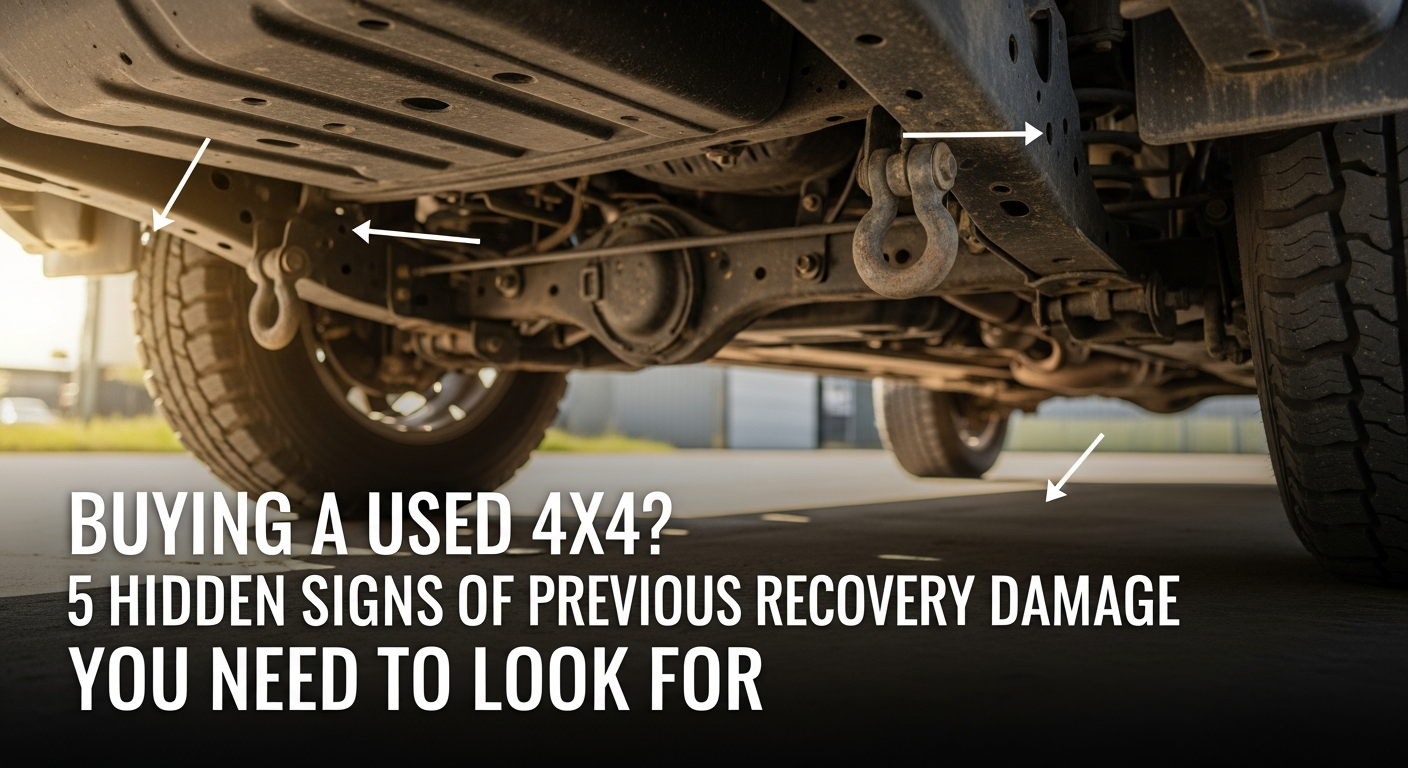
When you are in the market for a used truck—whether it’s a single addition to your driveway or a fleet expansion—you know the basics. You check the oil, kick the tires, and look for rust. But there is a silent killer of 4x4s that doesn’t show up on a vehicle history report: recovery abuse.
A truck can look pristine on the outside but suffer from deep structural trauma caused by “yank and pray” recoveries. When a previous owner gets stuck and uses a kinetic rope or a chain to violently jerk the vehicle out, the shock load travels through the entire chassis.
Before you hand over the cash, here are five specific questions you need to ask during your inspection to ensure you aren’t buying someone else’s mistake.
1. Is the Frame Actually Straight?
We aren’t talking about collision damage here. We are talking about “diamonding.” When a truck is snatched hard from a single tow point—especially if it was buried deep in mud—the frame can stretch or twist diagonally.
To check this, park the truck on level ground. Look at the bed gap (the space between the cab and the truck bed). Is it perfectly even on both sides? If the gap is tight at the top on the left but wide on the right, the frame has likely been tweaked by a heavy, off-angle recovery.
2. Are the Factory Tow Points Oval-Shaped?
Factory recovery loops are designed for static pulls, not dynamic yanks. Grab a flashlight and look closely at the bolt holes where the tow hooks attach to the frame.
If the holes look slightly oval or elongated instead of perfectly round, or if you see flaking paint right around the welds of the hook, that metal has been stressed beyond its yield strength. It means the truck was subjected to forces it wasn’t built to handle.
3. Does the Differential Pinion Seal Leak?
Shock loading doesn’t just bend metal; it blows seals. When a driver spins the tires wildly in the mud and they suddenly catch traction, the shock wave snaps back through the axle to the differential.
Crawl underneath and look at where the driveshaft enters the rear differential. Is it wet? A leaking pinion seal on a relatively low-mileage truck is a classic sign that the drivetrain has been shocked repeatedly.
4. Is There “Play” in the U-Joints?
While you are under there, grab the driveshaft and try to rotate it back and forth by hand. There should be almost zero play. If you hear a “clack-clack” noise or feel significant movement, the universal joints (U-joints) are worn. Premature U-joint failure is almost always a symptom of high-torque stress—exactly the kind generated when a driver tries to power their way out of a bog instead of using proper traction tools.
5. How Do You Avoid Being the Seller of a Damaged Truck?
If you are buying a truck, you are looking for these signs to avoid a lemon. But if you are a fleet manager or an owner-operator, your goal is to ensure your trucks never end up in this condition.
The damage we just described—twisted frames, blown seals, and stressed metal—comes from one specific behavior: relying on momentum and brute force to get unstuck. It happens when drivers panic and start yanking on straps because they don’t have a better option.
The smartest way to preserve your vehicle’s resale value and structural integrity is to remove the need for violent recoveries altogether. Instead of shocking the chassis, you should be enabling the tires to do the work they were designed to do.
Equipping your vehicle with a TruckClaws™ Heavy Duty Truck Kit eliminates the need for the “yank.” By installing these traction aids, your truck can slowly, methodically crawl out of mud, snow, or sand under its own power. There is no shock load, no frame twisting, and no damage to the drivetrain. It is the difference between a $5,000 repair bill and a 15-minute delay.
Conclusion: Inspect for the Invisible
A shiny coat of wax can hide a lot of sins, but it can’t hide the physics of a bad recovery. By checking the frame alignment, tow points, and drivetrain for signs of stress, you can spot a truck that has lived a hard life off-road.
And remember, the best way to keep your current fleet off the “damaged goods” list is to ensure your drivers have the right tools to get unstuck without tearing the truck apart.

The founder and partner of Flora Fountain, Shefali leads the Content and Technology divisions. A one-time engineer who started her career writing front-end code, she took a detour sometime during her 9 years in New York, studied journalism and started writing prose, poetry and sometimes jokes. She now has 15...